Why Am I Always Tired? · A book + 2 printable tools

One scene, one week: 7 days instead of 30, and you keep your coffee

A 5-minute test shows you which moment of your day drains you most, and the 7-day plan is already mapped out around it

For women 30+ juggling a job, and often kids too. Your sleep seems fine, but you're out of gas from the moment you wake up

$14.99Price goes up 1¢ every 5 seconds
  • Your main scene written down after a 5-minute test
  • The book + 2 printable tools in your inbox right after payment
  • 14-day money-back guarantee
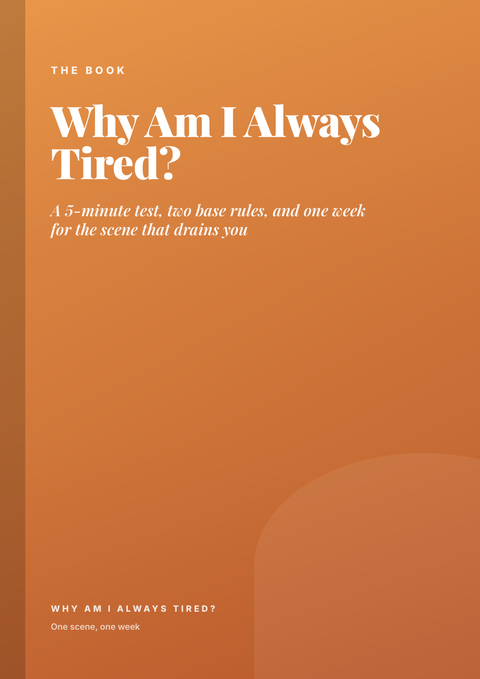
Cover of the e-book Why Am I Always Tired? One scene, one week

Sound familiar?

Tick the scenes that sound like your day

If you saw yourself in at least two of these scenes, you're not lazy. Your tiredness follows its own route through your day, and you can trace it

The tiredness chain

Problems never come alone: each one drags the next one in

Tiredness rarely lives in just one place. More often it's a chain, and each link grows out of the one before it

  1. Going to bed late

    Your day went by without a single minute for yourself, so you claw that time back at night with your phone. There's a name for this: revenge bedtime procrastination. If you went to bed right now, you'd fall asleep

  2. Morning fog

    For the first 15-60 minutes after you get up, your head feels foggy. Sources call this sleep inertia. Sleeping more than 9 hours can make that grogginess worse

  3. Coffee

    Caffeine really does clear the morning fog. But too much coffee hurts your sleep, and the next morning is harder. Coffee relieves the symptom while the cause stays put

  4. A heavy lunch and sweets

    You don't have much energy left by lunch, so you reach for a carb-heavy lunch and a sugary snack from the office kitchen

  5. The 3 p.m. crash

    Roughly between 1:00 and 3:00 p.m., your body clock has a natural dip. Add a heavy lunch on top, and by then your morning coffee has already worn off

  6. An evening with no energy and no time of your own

    Your head is fried from small decisions, while your body sat all day and never got tired. And back to going to bed late: the loop closes

When you try to fix everything at once from a long list of causes, you quit before you reach the end of the list. That's why in this book you pick one link, stick to two simple rules, and spend a week watching what changes in your check-offs

How the book works

One scene, one week: your week on paper a week from now, instead of yet another "I'll start Monday"

It takes three steps, and at each one you can see how much is left. The fourth question has its own chapter

  1. "Where do I start if everything fits?"

    5 minutes for the test

    You answer "often / sometimes / rarely" and see your main scene. If you saw yourself in all five, you start with the scene that sets off the others

    Chapter 1 · The test: five scenes of tiredness
  2. "How do I do this without giving up coffee?"

    Tomorrow morning, your first check-off

    Two base rules for the whole week: get up at the same time, and have your last cup of coffee before lunch. They don't take any extra time

    Chapter 2 · 7-Day Tracker
  3. "I don't have an hour a day"

    7 days, one task a day for your scene

    Days 1-2, days 3-4, days 5-7, each with its own task, no more than 10-15 minutes per the plan. On day seven your week's page is filled in

    Chapters 3-6 · 7-day plans
  4. "When is it a doctor thing?"

    The doctor card from day one

    With persistent fatigue, every source says to see a doctor and get tested. The book has a separate chapter on this and a card you can use right away

    Chapter 7 · Questions for Your Doctor
$14.99Price goes up 1¢ every 5 seconds
  • Your week on paper in 7 days, one task a day
  • The book + 2 printable tools in your inbox right after payment
  • 14-day money-back guarantee

What's different

Why this book doesn't belong on the same shelf as other energy books

A rule for choosing one scene

With lists of causes, everything fits and there's nowhere to start. Here, the test shows your main scene, and if you saw yourself in all five, the rule tells you which one to start with

A week instead of a month

Of the six similar products I found, four are built around 30 days. Here, the first cycle lasts 7 days, and after just the first week in the tracker you decide what's next

Coffee stays

The only thing that changes is the time of your last cup: before lunch

The medical line is built in

If something medical is going on, the book doesn't show you the door: there's a separate chapter for that and a doctor question card from day one

A source for every fact

Everything about sleep, caffeine, the after-lunch dip, and medical causes is backed by an open source: Sleep Foundation, Cleveland Clinic, and others. The minutes and days in the plan are marked as plan guidelines, so you can see what's fact and what's a plan guideline

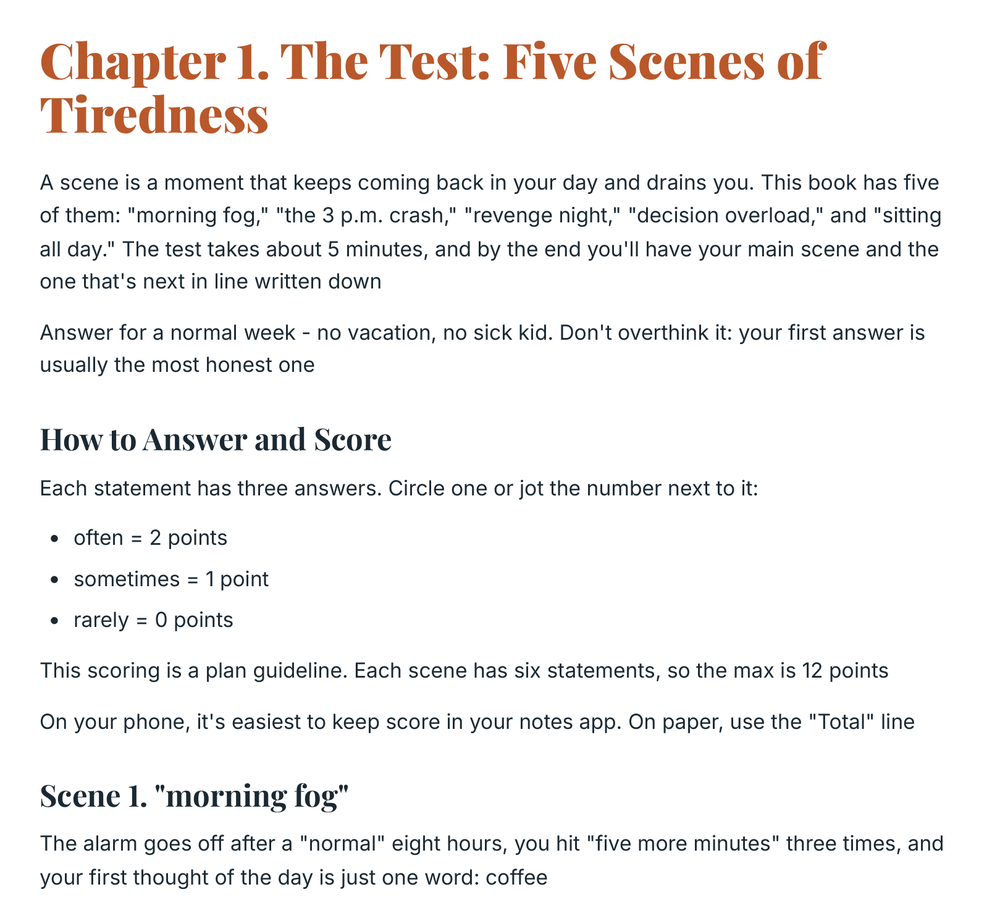
Page from Chapter 1, The Test: Five Scenes of Tiredness, how to answer and score, and the six statements of the morning fog scene

Answers the question: which scene of my day is eating up my energy?

An ebook in PDF: an introduction and 8 chapters. Each part answers one question and ends with a concrete result. Easy to read on your phone

See all 9 parts and what each one gives you

What's inside:

  • Introduction. If you've read the lists of causes and saw yourself in all of them: why the lists didn't help, how the book works, and what it will take from you: 7 days and one task a day

  • Chapter 1. The test: five scenes of tiredness: 5-6 statements per scene, scoring, a rule for choosing if all five fit, and red flags that mean see a doctor first. Your main scene and the one next in line are written down

  • Chapter 2. Why it's all connected: the whole chain, the eight-hour paradox, what caffeine does, the myths "sleep more" and "I'll catch up on the weekend," and your two base rules or their swap

  • Chapter 3. "Revenge night": how to go to bed earlier without fighting yourself. A 7-day layout of 3 tasks, plus options for moms of little kids, for shift workers, and for men

  • Chapter 4. "Morning fog": sleep inertia, getting up at the same time, weekends included, a 7-day layout of 3 tasks, and what to do if your mornings don't change

  • Chapter 5. "The 3 p.m. crash" and coffee: your last cup before lunch; days 1-2 protein and fiber at lunch, days 3-4 nuts or fruit instead of sweets, days 5-7 a 10-minute walk after lunch. No diets, no counting, no bans

  • Chapter 6. "Decision overload" and "sitting all day": the invisible load, three tricks that clear out small decisions before your day starts, movement without a gym, and two 7-day layouts

  • Chapter 7. The honest line: when it's not a book thing, it's a doctor thing: common medical causes, red flags, tests sources mention (ferritin, thyroid, blood sugar), and how to bring your tracker as your week on paper

  • Chapter 8. Week 2 and beyond: how to read your tracker, add your second scene, the "not from scratch, just from tomorrow" rule, and when to retake the test

What you walk away with:

  • Your main scene, and the one next in line, written down
  • Your week on paper: 7 tracker rows that show what changed
  • A clear next step: the next scene, or the doctor with your questions

"Nobody's taking your sweets away: for a couple of days they just get some competition"

$14.99Price goes up 1¢ every 5 seconds
  • Your week-two plan written down by the end of chapter 8
  • The book + 2 printable tools in your inbox right after payment
  • 14-day money-back guarantee

Two printable tools included

One page for your week, one page for your doctor

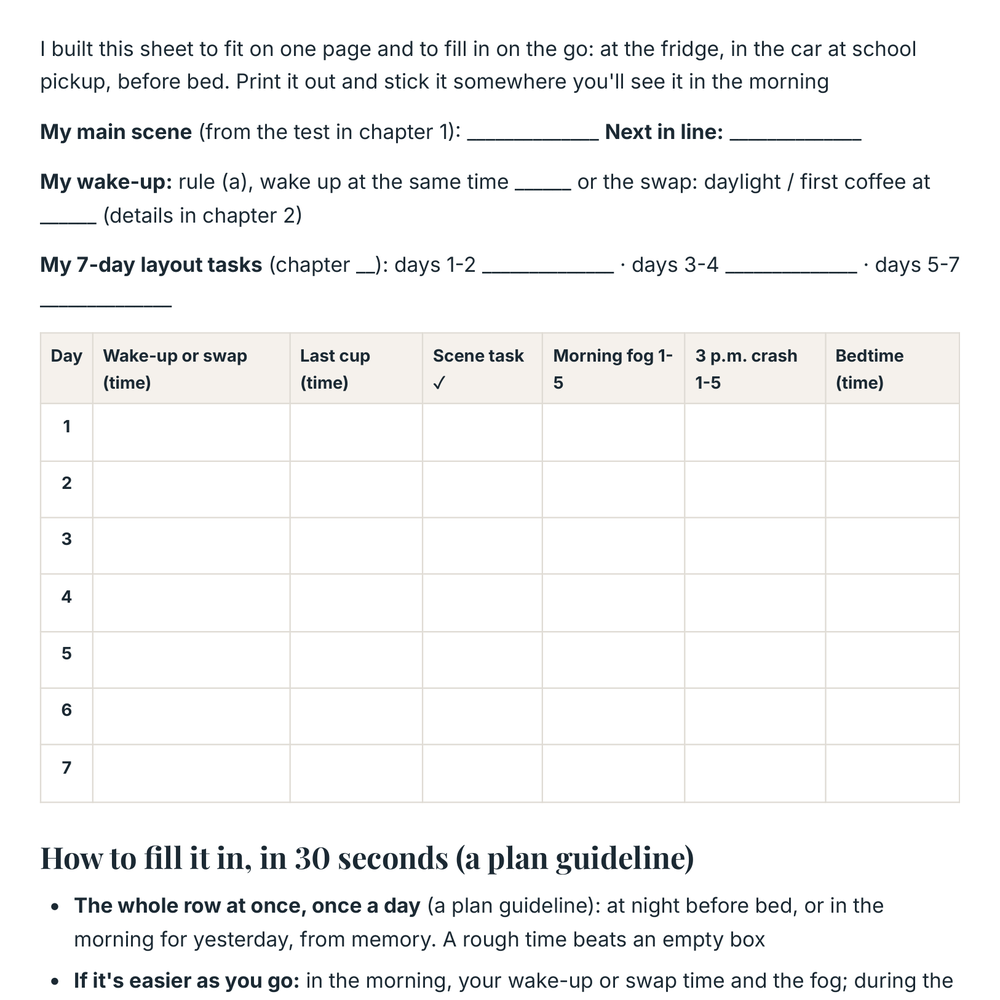
The 7-Day Tracker: main scene, wake-up rule, 7-day layout tasks, and seven rows for wake-up, last cup, scene task, morning fog, 3 p.m. crash and bedtime
Tool 1 · 7-Day Tracker, as it is in the PDF

7-Day Tracker

One page for the week: your main scene and 3 check-offs a day (wake-up or its swap, last cup, the scene task), plus your bedtime, morning fog, and 3 p.m. crash on a 1-5 scale. You can bring this same sheet to your appointment as your week on paper

Takes away the fear of "I'll read it and set it aside, like always." Three quick check-offs every day, and after a week you can see what got done

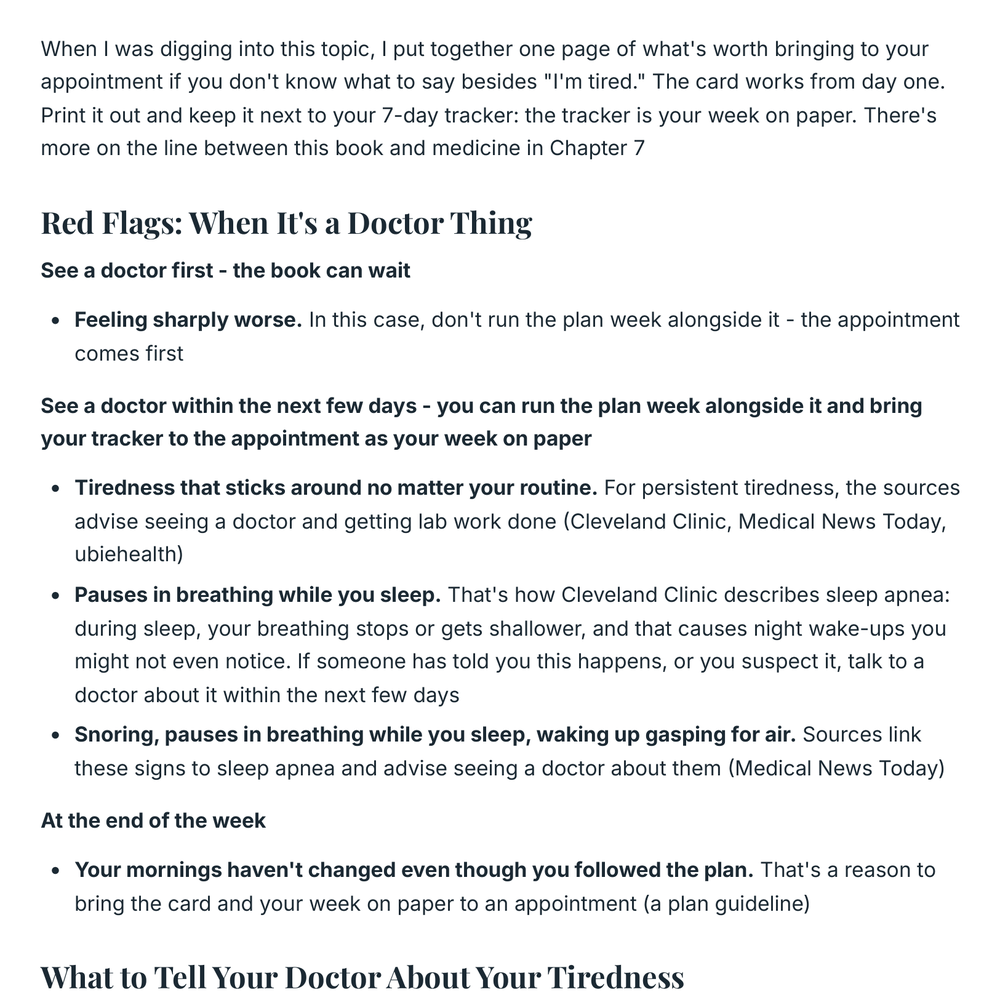
The Questions for Your Doctor card: red flags by urgency and what to tell the doctor about your tiredness
Tool 2 · Questions for Your Doctor, as it is in the PDF

"Questions for Your Doctor" card

One page in large print: red flags, what to tell the doctor about your tiredness, which tests you can bring up

Takes away the fear of "something's wrong with me, but I don't know what to take to the doctor." The card is useful from day one, and the plan runs alongside it

See it before you buy

Check yourself: 3 questions from the test

Answer each one: often, sometimes, or rarely

"I get my hours of sleep, but for the first half hour after I get up, I'm walking around in a fog"
Chapter 1 · Scene "morning fog"
"After lunch my eyes start closing, and my hand reaches for something sweet or for coffee on its own"
Chapter 1 · Scene "the 3 p.m. crash"
"In the evening I'm exhausted, but I still scroll my phone past midnight"
Chapter 1 · Scene "revenge night"

Answered "often" at least once? The book has the full five-scene test and a rule for which one to start with if they all fit. Here is what a plan chapter looks like inside:

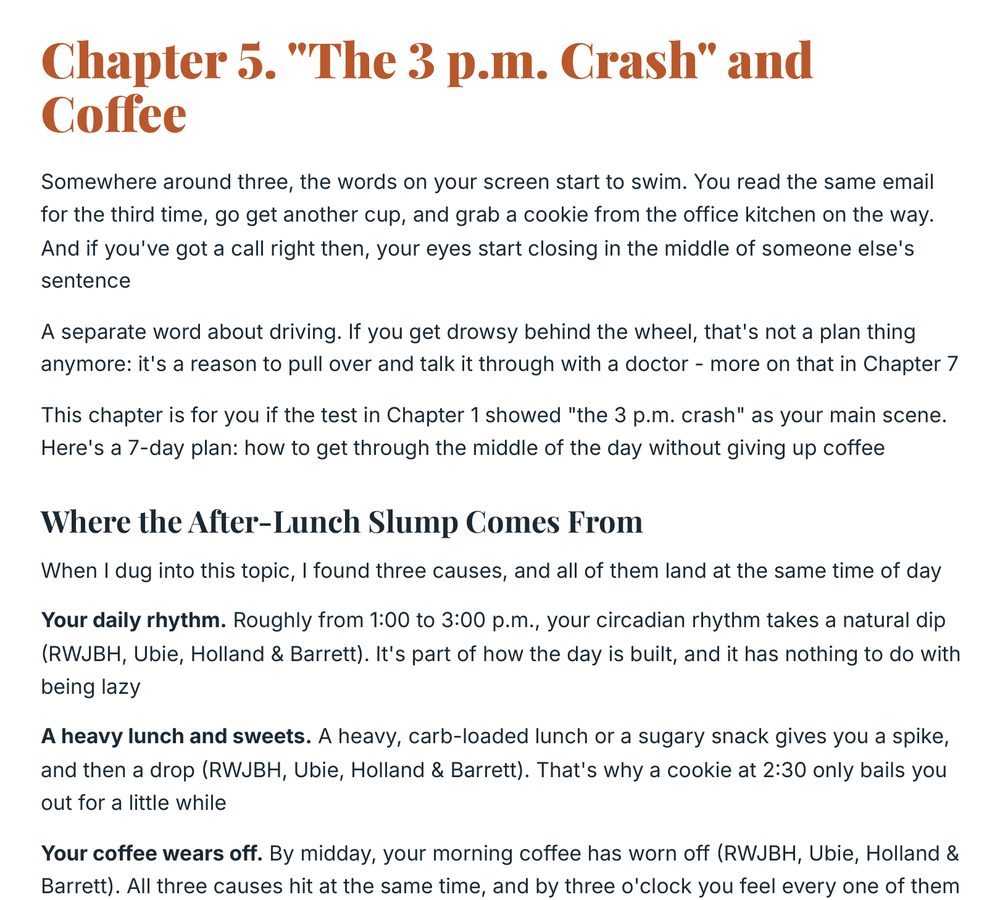
Opening page of Chapter 5, The 3 p.m. Crash and Coffee: the scene, a word about driving, and where the after-lunch slump comes from, with sources
Chapter 5 · "The 3 p.m. crash" and coffee: the opening page, as it is in the book
$14.99Price goes up 1¢ every 5 seconds
  • The full five-scene test: your main scene in 5 minutes
  • The book + 2 printable tools in your inbox right after payment
  • 14-day money-back guarantee

In their own words

How people describe it

Search queries and article headlines about fatigue

"Always tired after 8 hours" · "3pm slump" · "Can't function without coffee" · "Tired but wired" · "Mentally exhausted even if nothing big happened" · "If I have to make one more decision I'll scream"Search queries and article headlines, not reviews of this book

How readers talk about books on fatigue

"List after list of things that can cause fatigue" · "Nothing I didn't already know"Readers on books in this genre, Goodreads

What you won't have to do

  • Give up coffee

    Coffee stays - only the time of your last cup changes

  • Starve yourself or count calories

    No diets, no counting, no bans

  • Find an extra hour in your schedule

    One task a day, no more than 10-15 minutes per the plan

  • Fix your sleep, food, movement, and head all at once

    You change one scene. The others wait until next week

  • Figure out on your own what to do on which day

    What to do on which day is already planned for you

  • Guess whether it's time to see a doctor

    Red flags in chapter 7, and the doctor card from day one

From today to day 7

How it comes together into a system in 7 days

  1. Today

    5 minutes for the test. Your main scene and the one next in line are written down, and "where do I start?" is settled

  2. Tomorrow morning

    Your first check-off in the tracker, when your alarm goes off

  3. Days 1-2, 3-4, 5-7

    One task a day for your scene. A missed day doesn't reset anything: the next day, you simply fill in the next row

  4. Day 7

    Your week's page is filled in. And you know what's next: the next scene or the doctor card

Here's what one row of the tracker looks like (example, not a real person):

Wednesday, day 3. Scene: "the 3 p.m. crash"
Wake-up 6:45 · Last cup 11:30 · Today's task: nuts instead of cookies ✓
Morning fog 3 out of 5 · 3 p.m. crash 3 out of 5 · 11:15 p.m. bedtime

Seven rows like that are your week. A missed day just stays an empty row

$14.99Price goes up 1¢ every 5 seconds
  • Your first check-off tomorrow morning
  • The book + 2 printable tools in your inbox right after payment
  • 14-day money-back guarantee

Before / After

What's different by the end of the week

One scene and one week instead of yet another list of causes

  • Before: "Everything fits and nothing does, I don't know where to start"

    After: you have one main scene, and the others are calmly waiting for next week

  • Before: "Maybe I'm just like this"

    After: 7 tracker rows show which scene is eating your day. Next up: the next scene, or the doctor with your week on paper

  • Before: "I drink coffee all day and I'm still half asleep"

    After: your week on paper shows your days with the last cup before lunch, and you decide whether to keep that rule based on it, not on a hunch

  • Before: "I go to bed at 1 a.m. because it's the only time I get to myself"

    After: your own time is in your daytime schedule, and the tracker shows whether your bedtime has moved

  • Before: "Maybe something's wrong with me, but I don't know what to take to the doctor"

    After: you know your red flags, and you have the question card and your week on paper in hand

  • Before: "I bought a book about energy, read the beginning, and set it aside"

    After: week one is done, and your week-two plan is already written down

This is for you if

  • You sleep "fine" but wake up wrecked

  • You run on coffee and hit a wall at three

  • You're in bed with your phone past midnight, even though you were tired by lunch

  • By evening your head is fried from small decisions, and "what's for dinner?" feels like one question too many

  • You've read the lists of causes and don't know where to start

  • You have 10-15 minutes a day, tops, for anything new

The book works for men 30+ too: the picture of sleep, coffee, and late-night phone time is the same, and chapter 3 has a separate option for men

It's not for you if

  • You're looking for yet another long list of tips to read and set aside. Here you get a test and one task a day

  • You want a plan to quit coffee and sugar cold turkey. Here coffee stays, and sweets get swapped for a different snack, no bans

  • You expect the book to replace lab tests and a doctor's appointment

  • Your fatigue has suddenly gotten worse, or you have red flags from chapter 7. See a doctor first

The honest line

  • This book is not a substitute for medical advice

  • The book helps you understand your tiredness scene, spend a week making small changes, and prepare for a doctor's appointment

  • If you're under a doctor's care, follow the book's plan only together with that doctor's recommendations. The book's plan doesn't change anything your doctor has prescribed

If you suddenly feel much worse, see a doctor first - the book can wait

Why Am I Always Tired? One scene, one week

Everything you get

  • Why Am I Always Tired? The bookPDF ebook, an introduction and 8 chapters: the five-scene test, the tiredness chain, four 7-day plans, the honest line, week 2PDF
  • Tool 1 · 7-Day TrackerFor "I'll read it and set it aside": three check-offs a day, your week on one pagePrintable
  • Tool 2 · "Questions for Your Doctor" cardFor "I don't know what to take to the doctor": works from day onePrintable
Your price right now$14.99

One payment for the book and both tools. The price starts at $14.99 and goes up 1¢ every 5 seconds from your first visit, up to $19.99. When you open checkout, your price is locked for 10 minutes

$14.99Price goes up 1¢ every 5 seconds
  • Your main scene today, your week on paper in 7 days
  • The book + 2 printable tools in your inbox right after payment
  • 14-day money-back guarantee

Secure checkout via Lava · one-time payment, no subscription · card, PayPal, Apple Pay; iDEAL and SEPA in euros

After you pay, the book and both tools arrive in your inbox. You open the test, 5 minutes later your main scene is written down

14-day money-back guaranteeTake the test and try the week. If within 14 days you decide it is not for you, you get your money back in full. Send a direct message on Instagram to @dean_is01 with the email you used at checkout

Get both books as The Energy & Body Kit: Why Am I Always Tired? + Your Body After 30 for $20.99 instead of $29.98. See the bundle

Why not put it off

Your first check-off in the tracker is tomorrow morning, when your alarm goes off. In 7 days you'll have your week on paper: it shows clearly what changed, and you can bring it to a doctor's appointment

No need to wait for Monday, a vacation, or "a calmer week": the plan is built for the week you actually have

Questions

I don't have time for one more thing

The scene task slots into what's already in your day. You eat lunch anyway: in the "3 p.m. crash" plan, days 5-7 add a 10-minute walk after it. You grab a snack anyway: on days 3-4, there are nuts or an apple in your bag. The other scenes work the same way: tasks fit into lunch, your commute, dinner - not into an extra hour

I already know all this

You probably know a lot of causes of fatigue all at once. The book gives you a test for your main scene and days already planned around it

But all this is free online

There really are tons of lists of causes online, but they don't tell you what to do first. You've already read the two base rules right here - take them. The book has what doesn't fit into an article: a test that picks your scene, 7 days planned around it, and a tracker

Are you going to ban coffee and sweets again?

No. Coffee stays - only the time of your last cup changes. Sweets: no bans, no starving, no calorie counting

How is this different from other books on energy?

Those usually give you a month and advice on everything at once. Here, the test picks one scene, the week for it is already planned, and your first check-in with the tracker comes after 7 days

The author isn't a doctor. Why should I trust this book?

Every fact about sleep and caffeine is backed by an open medical source, so you can check it yourself. The week's plan is marked as plan guidelines, and medicine stays with doctors: that's what chapter 7 and the question card are for

I have a baby, I wake up at night, or I work shifts

The book has a separate option for exactly that: the "get up at the same time" rule gets swapped for a different daily anchor that holds no matter when you get up, and you start with a daytime scene

What if something medical is going on?

That's exactly what chapter 7 and the "Questions for Your Doctor" card are for. With persistent fatigue or red flags, you can go to the doctor right away, without waiting for the end of the week, with your week on paper and questions about tests: ferritin, thyroid, blood sugar

I'll fall off in week two, like always

A missed day doesn't reset your week, and chapter 8 helps you write down your week-two plan so it doesn't start from a blank page

I don't know anything about physiology. Will I get it?

Yes. The scenes are described through an ordinary day: the alarm, lunch, the evening with your phone. Terms like "sleep inertia" are explained in a sentence, and the tasks in the plan are simple: a walk after lunch, nuts instead of cookies

How do I get the book?

Lava sends the book in PDF and the two printable tools to the email you enter, right after payment. They also open right away on your order page, with an Open button for each file. The book is easy to read on your phone, and you can print the tracker and the card. Nothing is shipped

What if it's not for me?

Within 14 days, send a direct message on Instagram to @dean_is01 with the email you used at checkout, and you get your money back in full

P.S. One scene, one week

To get started, you don't need to work through a long list of reasons you're tired. All it takes is one scene and one week: 5 minutes for the test, your first check-off in the tracker tomorrow morning, and your coffee stays. In 7 days you'll have your week on paper and a clear next step, and the doctor card is already in your hands